

Cortisone injections often kick in within days. What patients do not always hear is that Alpha-2-Macroglobulin (A2M) can too. At Solutions Regenerative Medicine in Gilbert, Arizona, Dr. Mareshah Dunning, NMD uses A2M for a range of pain and inflammation conditions (joint arthritis, tendon and ligament issues, nerve-related pain, and autoimmune flares). Many patients notice pain relief and improved mobility much sooner than most educational content suggests, ranging from same day to within a few weeks, with continued improvement building over the following weeks.
Why A2M Works Over Weeks: The Three Phases of Healing
Healing moves through three phases: an inflammatory phase (roughly the first week of an acute injury, sometimes longer, and often stuck for months or years in chronic conditions), a proliferative phase (roughly weeks one through three, when cells begin to rebuild), and a remodeling phase (beginning around two to three weeks after injury and continuing for months or years as new tissue matures).
A2M works in the first phase. When it is injected, it immediately begins binding the inflammatory signals (IL-1, IL-6, TNF-α) driving pain, which is why many patients notice anti-inflammatory relief within days.
The bigger issue is what happens next. In chronic arthritis, tendinopathy, and similar conditions, the joint stays stuck in the inflammatory phase. The pro-inflammatory (M1) immune cells driving damage never make the shift to the reparative (M2) state that starts tissue repair, so the joint keeps cycling through inflammation instead of moving forward. That failed conversion is what keeps so many people in chronic pain and inflammation.
A2M’s job is to lower the inflammatory pressure so the joint can shift out of that stuck state and progress into the reparative phase. In the published clinical trial, pain and function continued to improve through the full six-to-twelve-week measurement window, consistent with a joint moving through the healing phases rather than staying trapped in chronic inflammation.
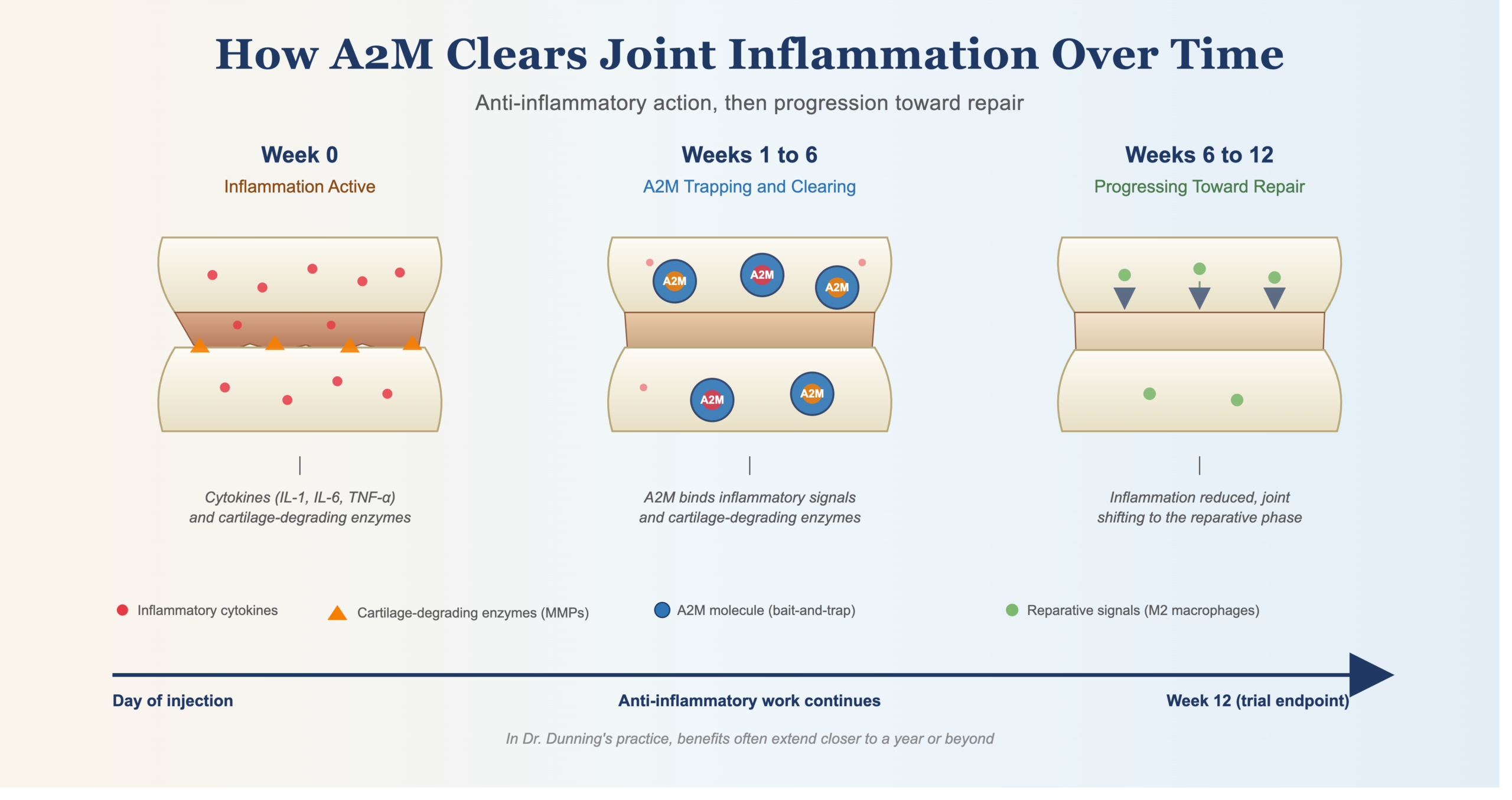
The A2M Timeline, Week by Week
Timeframe | What Is Happening |
Days 1 to 3 | Injection completed. Many patients feel meaningful anti-inflammatory relief within days. Others notice mild soreness at the injection site. |
Days 4 to 10 | Injection-related soreness can continue up to seven to ten days in some patients. Normal, not a treatment failure. |
Weeks 2 to 6 | Anti-inflammatory work continues in the joint. Improvement builds for patients who did not feel relief in the first week. |
Weeks 6 to 12 | Improvement typically continues to build. Pain, function, and activity level keep improving for most patients through this window. |
After 12 weeks | Further improvement is possible; Dr. Dunning follows up to plan next steps. |
What Affects How Fast A2M Works for You
Individual response is shaped by a handful of factors. Some are about you; others are about how and when A2M is used.
How advanced or chronic your condition is
A2M is best suited to conditions where inflammation or degeneration are the primary drivers of pain, whether that is early or moderate arthritis, an inflamed tendon or ligament, an autoimmune flare, or nerve-related inflammation. In those settings, patients often feel change sooner because A2M is targeting the actual problem. Advanced structural damage can still get meaningful relief from A2M’s anti-inflammatory and anti-degeneration effects, but a deeper conversation about fit matters at that stage. Regenerative medicine is an alternative to surgery and opioids; it is not something that reverses advanced structural change from a single injection. Upper-tier options like BMAC or micronized fat may be a better match for advanced cases, alone or in combination with A2M.
How active your inflammation is right now
How quickly you notice change often depends on how active your inflammation is at the time of the injection. In Dr. Dunning’s practice, patients presenting with a flare (visible swelling, warmth, stiffness) often feel change sooner than patients with more chronic, low-grade inflammation. A2M binds inflammatory signals as it encounters them, so a joint driven by high active signaling responds faster than one driven by diffuse chronic inflammation.
Whether A2M is a stand-alone treatment or a preparatory step
A2M can be used as a stand-alone anti-inflammatory treatment or as a preparatory step before an advanced regenerative treatment like PRP, BMAC, or micronized fat. A2M’s own effect unfolds on the same timeline in either case; what changes is how the injections are stacked. When A2M is used as a lead-in, the next regenerative treatment is given after A2M has done its anti-inflammatory work and the joint microenvironment has improved, so the growth factors in the follow-up injection land in a calmer environment. Exact timing is adjusted based on how the overall plan is structured and each patient’s individual response.
A2M and PRP should be given as separate injections within a treatment plan, not combined in the same syringe. A2M binds matrix metalloproteinases (MMPs); while some MMPs contribute to cartilage breakdown, others are needed for remodeling and building tensile strength, and A2M cannot differentiate between them. Sequencing the two injections separately protects the mechanism of both.
How well you support recovery afterward
A2M works best when it is not doing the job alone. Following the Regenerative Health Diet reduces the inflammatory inputs (refined sugar, alcohol, processed foods, refined oils) that would otherwise slow the reset A2M is creating, and caffeine and energy drinks are best limited for one to six weeks post-injection because they keep the nervous system in a sympathetic (fight-or-flight) mode instead of the parasympathetic (rest-and-digest) state where healing actually happens. Physical therapy or corrective movement work is equally important because A2M calms the inflammation, but restoring joint mechanics, strengthening stabilizing muscles, and correcting movement patterns is what keeps the joint from re-triggering the same inflammatory cycle. If your arthritis has a systemic driver such as an autoimmune condition, metabolic dysfunction, or hormonal imbalance, Dr. Dunning addresses those root causes in parallel, because A2M in a single joint only holds if the systemic inflammatory pressure is reduced too.
What your treatment goals are
A2M works on two timescales at once. The anti-inflammatory relief is what most patients notice within the first weeks. The cartilage-protective effect is quieter: A2M binds the matrix metalloproteinases (MMPs) and aggrecanases that break down cartilage over time, which slows osteoarthritis progression but is not something you feel week to week. If your primary goal is symptomatic relief, the first-weeks window is what to watch. If your goal also includes slowing arthritis progression, both effects are happening in parallel.
Your individual biology
Age, metabolic health, sleep, and stress levels all shape response speed. Patients addressing the systemic drivers underneath their condition, not just the joint itself, tend to see the strongest and most durable results.
One quick note on the cortisone comparison: in the published clinical trial, patients in the A2M group continued to improve on four of five patient-reported outcomes through twelve weeks, while the corticosteroid group had returned to baseline on those same four measures by twelve weeks.
How Dr. Dunning Approaches A2M Specifically
Dr. Dunning treats A2M as more than a one-shot injection. She uses it in three specific ways: as an anti-inflammatory alternative to a steroid injection, as a preparatory step before an advanced regenerative treatment like PRP or micronized fat (with sequencing timing based on the overall treatment plan), and as an added therapy layered into a diagnostic injection. Every A2M injection is placed under ultrasound or fluoroscopic guidance, and A2M is prepared using the Alpha2Active concentrating system. Recovery recommendations are individualized to each patient and may include elements of Dr. Dunning’s Regenerative Health Diet where appropriate to support the anti-inflammatory reset A2M is designed to create.